
Our Story
From 1200 to today:
street food at last
The Panattonin has existed for centuries: it’s documented in a 19th-century dictionary and gives its name to a Milanese play from 1878. We’ve simply put it back in the oven.
Since 1200
Small, and made all year round
Panettone has delighted Milanese palates since 1200 AD. But the idea that it’s only a Christmas cake is recent: it was traditionally made all year round, in a much smaller size.
Don’t take our word for it. In the third volume of the Vocabolario milanese-italiano, the philological reference compiled in the 19th century by Francesco Cherubini, there’s an entry dedicated to it: panatton o panatton de Natal.
«A kind of wheat bread dressed with butter, eggs, sugar and small raisins (ughett) or sultanas which, cut crosswise like an almond while still dough, comes out with many little horns once baked. We usually make the large kind, of a pound or more, only at Christmas; but in small rolls of the same or similar dough it is made all year round by the offellai (pastry bakers), and we call it panattonin.»
That’s the whole story: the small size, the year-round production, the offellai who baked it, and above all the name — not an affectionate nickname we made up, but a word Milanese people really used.
Milan, late 19th century
When speaking Milanese was a choice
A few decades after that dictionary, the same word ended up on stage. To understand how, you have to look at what was happening in Milan.
After Italian unification, dialects came to be seen as lowly, something to move beyond. Theatres, too, switched to Italian. It was in reaction to that climate that modern Milanese theatre was born: Camillo Cima debuted at the Teatro Gerolamo in May 1869, and shortly after, Cletto Arrighi founded the Teatro Milanese.
Writing in Milanese back then was an act of cultural resistance. The audience was working-class — shopkeepers, craftsmen, seamstresses, the very trades that fill Cima’s plays.
1827
— 1908
Camillo Cima
A Milanese architect, painter, playwright, journalist, illustrator and publisher. First anti-Austrian, later broadly anti-establishment.
He devoted much of his theatre to the “belly of Milan”: the Meneghini and the Cecche (traditional Milanese character types), the cafés, the shops, the streets.
The playwright
A man who stood with the people
Cima wasn’t a one-work author: he wrote dozens of plays in Milanese dialect — “I deslipp del sur Bartolamee”, “El mercaa de Saronn”, “On pret scapusc” — alongside Arrighi and Edoardo Ferravilla, the greatest Milanese actor of all time.
And here the word plays a double game. For Cherubini, the “Panattonin” is the small cake; but in the mouths of Milanese speakers, “panatton” is also the baker, and with the “-in” diminutive it becomes the baker’s apprentice. The cake and the person who bakes it share the same name — precisely the gallery of working trades that Cima put on stage.
The plot
A note hidden inside the cake
Ambrosin doesn’t dare confess his feelings. So he hides a little note inside a Panattonin, and has it delivered to Letizia.
Act one, 1827. The Spanteghetti household, Christmas Eve. The family prepares panattonin to give as gifts and organises a small lottery of pledges. Ambrosin, young and from a modest family, entrusts his feelings to a gesture rather than to words. Letizia finds the note. Between the two of them, the confession plays out like this: in silence, under the knowing eyes of the household staff.
Act two, 1877. Exactly fifty years have passed. Letizia married someone else; Ambrosin — now Ambroeus, seventy years old — has remained a lifelong friend. Their grandchildren, Evelina and Francesco, are in love and can’t bring themselves to say it. The old secret of the note resurfaces, never told in all those years. It’s that memory that gives the two young people the courage their grandparents once lacked.
On stage, the panattonin is no ordinary cake: it’s the engine of the whole play, carrying something precious and hidden inside it.
In short
The timeline
1200
The bread of the nobility
Panettone begins to delight Milanese palates. It's not yet just a Christmas cake.
1814
The entry “Panattonin”
Francesco Cherubini records the word in his Vocabolario milanese-italiano: the small size, made all year round by the offellai (pastry bakers).
1827
The little note
Act one. Christmas Eve: Ambrosin hides a declaration of love inside a Panattonin meant for Letizia.
1877
Fifty years later
Act two. The next generation repeats the same gesture, and the circle closes.
1878
On Panattonin
Camillo Cima publishes the two-act play in Milanese dialect. Its title is the name we carry today.
2021
Back in the oven
Roberto brings the Panattonin back to Milan: small, light and baked all year round. Street food, as it deserves.
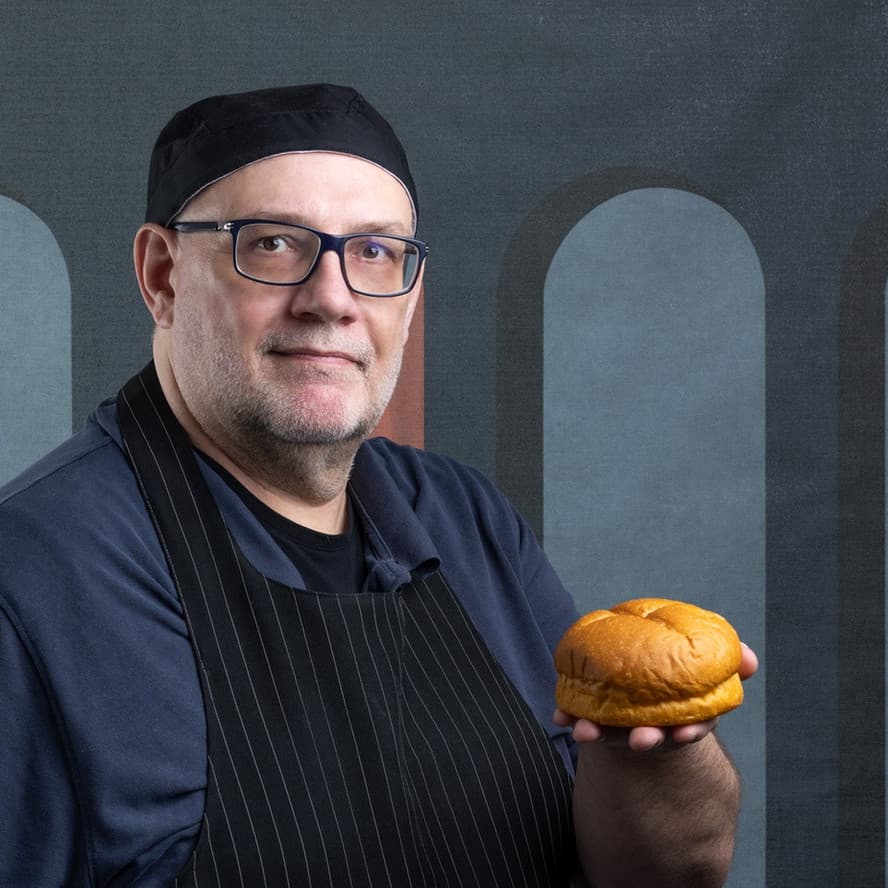
Today
And then Roberto arrived
A hundred and forty years after Cima, the Panattonin is back in the oven. Small as it was then, long-leavened, soft, light and filled with this city’s own cooking: ossobuco, cotoletta, busecca, mondeghili.
Two generations, the same celebration, the same gesture. Here with us, now, you can even eat it.